




Climate Change
|
Jul 03 2026
Climate Change
Can A New Convening of Willing Countries Finally End The Fossil Fuel Era?
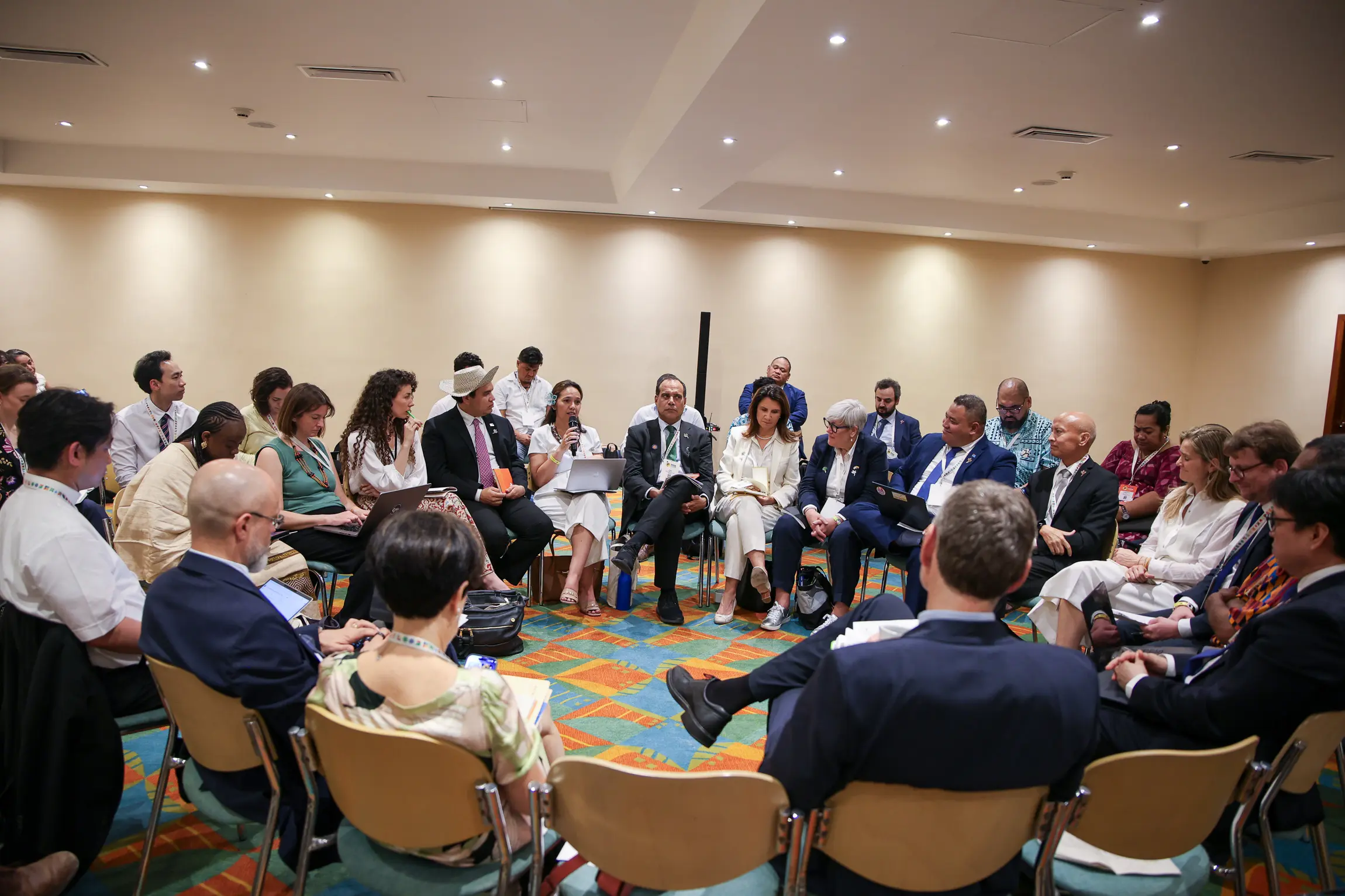
(image credit: Photo by IISD/ENB | Mike Muzurakis)
A very important event happened last week. The inaugural Conference for Transitioning Away From Fossil Fuels welcomed representatives from 57 countries, plus 400 scientists and academics to support in science-based decision-making, all of whom presumably pledge allegiance to a healthy and just version of Earth that runs on renewable, emissions-free energy. It’s purely coincidental that this meeting of clean-minded minds happened amidst the backdrop of a war that could very well be a pivotal timestamp in the energy transition. The timing of this conference could not have been more cosmically aligned with a global spotlight on the compounding negative externalities of global fossil fuel reliance. Planned and raised from the ashes of yet another failed United Nations Framework Convention on Climate Change (UNFCCC) Conference of the Parties (COP) discussing global climate action last November in Brazil, this new conference is a sign that bold leadership committed to properly addressing the climate crisis is alive and well, and most notably, will not be silenced.
One simple reason this group had to come together now is because the resulting document produced from COP30 last year failed to even mention the phase out of fossil fuels. The human activity of burning fossil fuels is the largest driver of climate change. To not be able to call the problem or solution by its name after 30 years of convening is worse than failure, it’s defeat. And so here we are with a smaller, yet not insignificant group of countries, who are committed to moving this blue ball forward on the one single action item that must happen if we are to salvage life on this planet: stop burning fossil fuels.
The Conference for Transitioning Away From Fossil Fuels convened April 24-29 in Santa Marta, Colombia, and was cohosted by Colombia and the Netherlands. They only allowed attendees who identify as the “coalition of the willing”, or people who know the climate emergency is upon us and who are done litigating this fact. Climate deniers and their allies were not invited, nor were they welcome, as they currently are at the COPs. This criteria alone demonstrates the beacon of hope this conference represents in the global arena. Obstructionists have no place in the quest for progress, and progress is the bedrock of climate action. We can only make progress and move forward by cultivating a space for unencumbered climate action.
And so at this next-gen climate conference, those in attendance were the rational, the logical, the realistic. They are the path-forgers, the new world expeditioners, the species-advancing innovators, all fighting against the resistance. They are the ones in positions of political power, of country-shaping influence. The ones choosing to take the politically risky, albeit only path forward, for all of us. Those making up this “coalition of the willing” are our representatives, ministers, leaders, and envoys who have chosen to not only hold the line, but crucially, to move it forward, no longer waiting for unanimous permission from the global disorder.
These founding 57 countries represent one third of the global economy. They will phase fossil fuels down and out. Most news articles reporting on the conference pointed out that it did not include the world’s top fossil emitters and exporters, such as the US, Saudi Arabia, Russia, China, and India, as if this were a defeatist detail. It’s not. Of course these parties would not be invited to a serious meeting to plan the actual transition away from coal, oil, and gas. They represent most of the very parties responsible for obstructing the current COP process, where decisions are taken by consensus and fossil fuel lobbyists outnumber most countries’ delegations, resulting in outcomes that align only with the wishes of the world’s lowest uncommon denominators. Dirty fuel keeps burning and global temperatures keep rising.
This isn’t to say that the UNFCCC has been a bust. Far from it. Humanity’s ground-breaking and significant attempt at global climate collaboration deserves immense credit. Getting 198 countries to ratify a treaty which aims to prevent dangerous human interference with the climate system is no small feat. It presumes we all agree that humans can and are interfering with our planet’s climate system. In 1995, The Kyoto Protocol set greenhouse gas emissions reductions targets for developed nations, pushing them to do something about the problem. And the 2015 adoption of the Paris Agreement gave our world the 1.5 north star dream and a hard number to rally around, that being the scientific recommendation to limit global warming to 1.5°C above preindustrial levels, with an upper limit of 2°C, in order to theoretically avoid the most catastrophic impacts of climate change.
But just eleven years later, we have failed. Many scientists believe we have crossed the threshold for 1.5°C, and we are on track to overshoot the devastating impacts of 2°C by 2100, which is now just one human lifetime away.
Still, without these previous achievements, things would likely be much worse. Since the Paris Agreement, there has been a mainstreamed push for countries to reduce their greenhouse gas emissions, leading to a shift in global energy investment, where clean energy funding now outpaces that of fossil fuel, with the latest numbers in 2025 showing investments of $2.2T and $1.1T, respectively. Additionally, we continue to see renewable energy records broken. Last year, all new electricity demand was met with clean power sources, and for the first time ever, renewable energy managed to just barely beat out coal as the top source of global electricity, according to global energy think tank Ember. This is due in large part to the drastic drop in solar costs over the past decade, now the world’s cheapest source of energy.
But these efforts have not directly addressed the source of the problem. The burning of fossil fuel not only persists, but continues to grow. The proof is in the numbers: we continue to break annual records for global emissions dumped into our atmosphere, which now holds CO2 concentrations of ~427 ppm, 50% above preindustrial levels. In 2025, CO2 emissions reached a record high 38.4 billion tons. Emissions have been increasing steadily since 1900, and even though developed nations have managed to flatten or even decline their trajectories in recent years, 2025 saw advanced economy countries grow emissions faster than developing and emerging markets for the first time in 30 years.
We are not listening to the science. We are not appropriately reacting to the reality of our warming planet. Yes, we need to continue building out renewable capacity at a much faster clip, but most importantly, we must retire the fossil system. To cease fossil fuel burning operations at a global scale or even at the regional level will require the most complex and detail-oriented multidisciplinary multi-decade effort that humanity has ever undertaken. Not many people are talking about this critical next phase. Presumably that is what the Conference for Transitioning Away From Fossil Fuels aims to do. Finally, we can get down to the nitty gritty of how The Great Transition gets done, followed immediately by getting it done. (One person working on exactly this topic is Emily Grubert who is doing extremely important work researching the details of what this mid-transition phase we are in could look like.)
In order to succeed, we must rethink our rules of engagement with each other, or else risk the end of a habitable Earth. In analyzing the many constructs of modern society (i.e. capitalism, the electoral college, the existence of lobbyists), over time it becomes painfully obvious to critical minds that previously written rules must be updated to reflect the circumstances of today. Humans evolve over time, priorities change, resources deplete, technologies advance. We cannot expect a system created generations ago to uphold within the physical, financial, and psychological parameters of today.
In the case of international collaboration to address the climate crisis, the Conference for Transitioning Away From Fossil Fuels looks like an enlightened and actionary evolution of the UN COPs. Per Carbon’s Brief’s detailed account of the conference, “ministers and envoys from across the world sat side-by-side in small meeting rooms to have open and frank conversations about the barriers they face in transitioning from fossil fuels to clean energy.” “The new format was described as ‘refreshing’, ‘highly successful’ and ‘groundbreaking’ by countries attending the talks”.
What this indicates to me is that the humanity was brought back into climate proceedings. The format of sitting in small circles for casual discussions about our world’s biggest challenges invites the human element of emotion and connection into the space. Human activity is what has gotten us into this mess, but it is actually due to activity that has been stripped of the human element of love. If love were involved, we would not bulldoze forests, mass murder species, and poison our communities. Those who carry out these horrific acts of pillage and pollution have shock-therapied themselves into living a life in lack of love. But love is the strongest, highest, most powerful force we possess as human beings. Love for our planet, our future, and each other, I would guess, was present in the Conference for Transitioning Away From Fossil Fuels.
My one critique of this conference and outcome is that none of the plans are mandatory. It’s all voluntary, just as in the UNFCCC. The question of how to enforce and make mandatory international agreements is a topic for a non-existent governing body in its own right. But so far the voluntary route hasn’t gotten us to where we need to be. Voluntary coalitions and treaties and agreements of any kind are built on shaky ground, and in this current era of world disorder, words are no longer good as gold. Even with this coalition of the willing, there is much reason to expect broken promises, not because of the individuals who attended the conference, but because of the fickle governments, entities, and citizens they represent. Until we see the “coalition of the transitioned”, we must remain extra vigilant in our efforts to push real action forward relentlessly, and at a much faster pace and greater cadence than once-yearly checkins.
Next year, the second Conference to Transition Away from Fossil Fuels will be held in Tuvalu, co-hosted by the island nation and Ireland. Tuvalu is already experiencing an accelerated version of climate impact, with rising seas encroaching upon their homeland. Outside of this intergovernmental arena for climate action, the rest of us have a job to do. We must stoke the flame for the human emotional connection that binds us. Our sisters and brothers of Tuvalu and all island nations floating in the vastness of our planet’s oceans are facing some of the nearest term risks. Their livelihoods, their cultures, their mere existence is endangered by sea-level rise caused by the conscious human decision to continue burning coal, oil, and gas for energy. To knowingly continue with the status quo that created this horrific circumstance would be heartless, murderous, and suicidal all at once. Is that our legacy? We have much more evolved options ready and waiting, and we have the ability of our intelligent brains to innovate the rest, should we choose to use this gift of human intellect. The choice is ours.